Fact or Fiction #9

Beginning with this Fact or Fiction, #9, I will be posting the character name on Monday and the answer on Friday. Here it is!

       The Accidental Samurai is based on historical figures as well as fictional characters. Every week on Friday I will post the name of a character and readers can guess whether the character is an actual person who lived in the Tenth Century or a fictional character. Each Monday I will post the answer. This weeks character:

Mechakucha no Kaze

Fact or Fiction #8 Answer

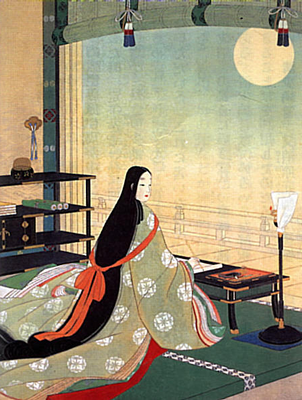
MurasakiShikibu.2  Fujiwara no Himiko is a fictional character, but she is based in part on two historical figures that lived centuries apart. Those figures are Queen Himiko (also called Pimiko), who ruled the Yamatai kingdom in Japan in the Third Century and Murasaki Shikibu, who lived during the Heian Era and wrote the Tale of the Genji (she is depicted in the picture above).

In The Accidental Samurai, Fujiwara no Himiko is a brilliant and talented woman who is keenly aware of the political disabilities faced by women in her time. She does not agree with the exclusion from politics and commerce women faced. Himiko has incredible strength, but most men only see her beauty. She refuses to dye her teeth black, her face white and paint her eyebrows, all important aspects of the aristocratic vision of beauty during the Heian era, but her natural beauty and strength shine through. Her inner-strength, political instincts, and leadership are modeled on the legends of Queen Himiko. Queen Himiko ruled from 189-248 C.E., and she is documented in contemporary Chinese writings. Much of what is known about her comes from Chinese records, but legends about her leadership and strength have entered Japanese culture.

The other character Himiko is based on is the author and poet Murasaki Shikibu, who wrote what many consider to be the world’s first novel, The Tale of the Genji. Himiko does not revel in the aristocratic society that Shikibu was a part of, but like Shikibu she is talented in the arts, which were highly valued during the Heian era. Also like Shikibu, her talent rises above her station in society.
Fact or Fiction #8

Dear Readers,

I apologize for the delay in posting Fact or Fiction #8, but here it is!

       The Accidental Samurai is based on historical figures as well as fictional characters. Every week on Friday I will post the name of a character and readers can guess whether the character is an actual person who lived in the Tenth Century or a fictional character. Each Monday I will post the answer. This weeks character:

Fujiwara no Himiko

Fact or Fiction #7 Answer

220px-Song_Taizu   Emperor Taizu of Song, also known as Zhao Kuangyin, was a real person. He founded the Song Dynasty and reunited much of China, which had been divided during the Five Dynasties period. His path towards becoming Emperor started out with a brilliant military career during the Later Zhou Dynasty. While the Later Zhou Dynasty never reunited China, there were plans to do so. After the last great Emperor of the Later Zhou Dynasty, Zhou Shizong died (he was replaced by his 7 year old son), Zhao Kuangyin was made Emperor through a mostly bloodless coupe in which the military made him Emperor.

Emperor Taizu then set out to unite much of China, and while he had some setbacks to North, he was able to unite much of the southern part of China. He also had other successes, including promotion of education with relative freedom of speech and inquiry by the standards of the day, promotion of art, engaged in economic reform and created a civil service exam which allowed civil servants to be appointed based on qualifications more than they had in the past. He also allowed science to thrive. There are also rumors that he was welcoming of foreigners loyal to China.

Fact or Fiction #7

The Accidental Samurai is based on historical figures as well as fictional characters. Every week on Friday I will post the name of a character and readers can guess whether the character is an actual person who lived in the Tenth Century or a fictional character. Each Monday I will post the answer. This weeks character:

Emperor Taizu

Fact or Fiction #6 Answer

200px-Fujiwara_no_Saneyori Fujiwara no Saneyori was a real person. As the novel shows, Saneyori served as Sadaijin (Minister of the Left) for Emperor Murakami, and he later served as Kampaku (a combination of Regent and Chief Advisor) to Emperor Murakami’s son, Emperor Reizei. Saneyori was extremely powerful in the political sphere even before he became Sadaijin. He served as Udaijin (Minister of the Right) earlier in Emperor Murakami’s reign.

There is no doubt that Saneyori was quite powerful in the politics at the time, but whether he and Emperor Murakami had any sort of conflict is unknown, and therefore the conflict in the novel is fictionalized. There is evidence that Emperor Murakami sought to lower taxes on the people, as in The Accidental Samurai, and that this attempt was resisted. Whether that resistance came directly from the Kugyo, as in the novel, or from local officials, is unclear.

Fact or Fiction #6

The Accidental Samurai is based on historical figures as well as fictional characters. Every week I will post the names of two characters and readers can guess whether the characters are actual people who lived in the Tenth Century or fictional characters. After two or three days I will post the answers. Today’s character:

Fujiwara no Saneyori

Fact or Fiction #5: Answer

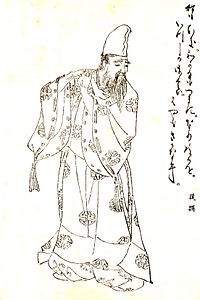
800px-MichizaneKo1884  The Kunai-Kyo was a real person. “Kunai-Kyo” was the title of the Head of the Imperial Household. In The Accidental Samurai, the Kunai-Kyo is also a close confidant of the Emperor. In the Heian era social rank was quite important, and someone holding the position of the Kunai-Kyo would have been of a high rank and would have had a lot of contact with the Emperor and his family. In the book, the Kunai-Kyo was given a higher social rank by the Emperor based on merit rather than family status. This  disturbed some people.

There are no known paintings of Emperor Murakami’s Kunai-Kyo. The above image is a representation of a Heian era aristocrat. Despite a good deal of research I was unable to determine the proper name of Emperor Murakami’s Kunai-Kyo. At first I created a name for the character, but after writing a good bit of the book I decided to refer to him by his title. He is a likeable and complex person, who is quite serious about his duties, so using his title rather than a proper name adds to his mystique.

Fact or Fiction #5

The Accidental Samurai is based on historical figures as well as fictional characters. Every week I will post the names of two characters and readers can guess whether the characters are actual people who lived in the Tenth Century or fictional characters. After two or three days I will post the answers. Today’s character:

The Kunai-Kyo

Fact or Fiction #4: Answer

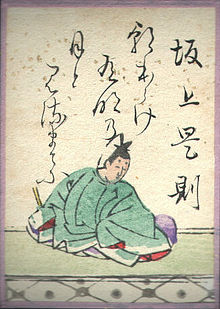
220px-Hyakuninisshu_031  Sakanoue no Mochiki was a real person. He was a famous waka poet. I was unable to find a painting of him, but the above picture is of his close relative, Sakanoue no Korenori, who was also a famous poet. Prior to the rise of waka poetry almost all Japanese poetry was written in Chinese. Waka poetry was written in Japanese. Both forms were popular throughout the Heian Period. Mochiki is also said to be the progenitor of the Kojima clan in Japan.

Sakanoue no Mochiki was appointed by Emperor Murakami as one of the Five Men of the Pear Chamber. These men were tasked with compiling the Gosen Wakashu, to this day regarded as one of the greatest works of Japanese poetry. Mochiki’s descendents became legal scholars and police officials. Not much is known about Mochiki himself, but the Five Men of the Pair Chamber were so named because they met in a room in the Imperial Palace that adjoined a garden with a beautiful pear tree. The Emperor lived nearby within the palace.

Poetry was highly valued in the Heian era, and because Emperor Murakami hand selected the Men of Pear Chamber, Mochiki and Murakami would have known each other and been in contact. The Accidental Samurai fictionalizes the depth of the friendship and political ties between Mochiki and Murakami, but it is possible such connections did exist.